Public speaking with my closest friend, anxiety

Me on stage at my first standup gig. It was a long road to get here, but it didn't have to be.
tl;dr: I battled anxiety and struggled with public speaking for about a decade, until I figured out that my anxiety was a strength that would help me to be a better presenter. You can take a shortcut by doing a stand-up comedy course earlier than I did and realising that anxiety about public speaking is not only normal, but a necessary nifty tool. Anxiety is the concentrated care you need to over prepare and keep you focused and aware to succeed on stage or wherever.
In this post, I will tell you about the public speaking anxiety tips and tricks I have received over the years and how I not only overcame debilitating anxiety on stage, but how I now channel anxiety to improve my public presentations.
Note: if you have anxiety outside public speaking that is effecting your quality of life, I would recommend seeing a licensed therapist. I found MCBT very helpful, but everyone is different, so please consult a professional.
My First Talk
My mouth is dry
My hands are shaking
I grab the bottle near me
and turn for an eternity

We can't watch this twaddle
This is cringe on a drip
No don't close the bottle!
You'll need another sip

He opens the bottle again
Over and over this is insane
Just leave the bottle open
Out of luck, Walter is broken
This is how my defence speech for my master's thesis went. I was continuously opening and closing a bottle of water with a screw cap. Each time I would open the screw cap, during which I would be totally silent, take a sip, think my thirst is quenched, close the screw cap, say a sentence and realise my throat is dry again, repeat. My voice was trembling so much it felt like I was in an infomercial on one of those vibrating exercise machines:

Imagine public speaking while you are on an exercise belt. Credit: Young Homer Simpson from the Simpsons.
I can only imagine how frustrated the audience must have felt. I am really sorry to everyone who had to sit through that torture.
Afterwards, one of the professors walks up to me. She has a tip for me, she suggests to calm my nerves, that I should have a drink right before I ever do another presentation again. So I took her advice.
Alcohol
I volunteered to do an intro to Go talk at a meet-up my friend organised for students. The only piece of advice I had received at this point on how I could improve my public speaking was to use alcohol. So I went into the public bathroom before the talk and snuck some whiskey into the Coca-Cola bottle I was going to drink while doing the presentation.
This definitely helped me have courage at the start of the talk, but by the end when it was time for Q&A, I was red-cheeked and fumbling through the questions. Not great, but I did get up there, so this was a step for me and I proceeded to do another one (gofuncyourself) of these talks with similar results.
Next, I worked up the courage to talk to Java developers at our company about why our team was using Go. Firstly, don't do this! People don't like change and if you are even remotely suggesting taking away their favourite toy, then you will be thrown off stage. Luckily I had my secret weapon and this time I wasn't hiding it. I had my bottle of whiskey on the table. This was one step forward, floor steps back. The senior Java developers were heckling me so much, that the rest of the audience was pouring my drinks. They all had this look of sympathy on their face as the senior developers kept on interrupting my presentation. I spent the weekend, sunken deep into the couch, not from the hangover, but from being depressed about how badly I had failed.

Who didn't cry while watching Maid
Lesson 1: Don't use alcohol. Even though alcohol can give you the courage to go on stage, it will also make you unable to properly engage with the audience. You do not want to suppress your reaction time on stage, the loudest laughs happen when you are reacting to the unforeseen.
Comedy is reaction. The energy you get from the audience is part of the show. – Logan Murray
Lesson 2: Know your audience. Don't pitch Go to Java developers.
Years later, I made a similar mistake by trying to sell GRPC to Rest developers. It also resulted in an antagonistic atmosphere. Some lessons you need to learn twice. Trying to convince people to change their mind is how you make them defensive. I recommend rather sticking to building awareness.
Preparation
Every few months, I would drive about an hour and a half to attend the functional programming meet-up in Cape Town, South Africa. The organisers suggested I do a talk. I was incredibly nervous to do a talk to such an intellectually intimidating audience, but luckily the organisers were very encouraging and supportive, even providing the foundational idea for the talk. This time I wasn't going to use alcohol and would need to solely rely on my preparation.

My drive from home to the Cape Town functional programming Meetup
I packed my talk full of topics: functional programming concepts, Indian classical music theory and Flow-based programming in a Digital Audio Workstation. It contained code in Go, Haskell, JavaScript and Greek Symbols. Something for everyone. I also made sure to practice my talk at least 10 times.
Up to this day, I still include 10 run-throughs as part of my process:
-
I write down each sentence, exactly as I plan to say it.
-
I try to say the words out loud without looking at what I wrote down and checking it afterwards to see how close I got. Trying to remember is proven to be the best way to get your brain to put effort into remembering. I learned this in a course on Learning: Learning How to Learn - Barbara Oakley. This course taught me that the brain only tries to remember something if you have tried to recall it yourself. Only then is it regarded as important enough to be stored for easy recollection. Basically the way to get items into your cache, is not to write to your database, but to attempt to read them.
-
Finally, I also give the talk to a small audience and update the script with their feedback.
The preparation paid off and even though I was nervous, the audience seem to enjoy it. They asked questions to make sure they followed along, took some videos of the demos, and after the talk we kept the music generator playing for at least an hour.

Cape Town Functional Programming Meet-up
This as an example of where anxiety is actually a strength, since it pushes you to prepare more than if you didn't have it. Over preparation throttles the anxiety and anxiety pushes you to over prepare.
This success gave me the confidence to practice more and do more talks to small groups at work. I have now done this talk several times and even worked up the courage to face the ridiculing crowd of senior Java developers again. This talk has gotten me two job offers and I have now turned it into a series of videos on YouTube.
Lesson 3: Preparation is not only respectful towards your audience's time, it also throttles your anxiety.
Years later, I was lazy and tried to cheat my process. I was giving a remote talk about Coq and I thought it would be okay to not memorise the talk and instead read it off of the presenter's notes. Afterwards, my friend told me it was super obvious that I was reading, since I took breaks during my sentences at un…natural places. Sometimes you have to relearn the most important lessons.
Practice makes presentable

I continued to practice and prepare more talks. I started with giving internal talks at work about projects I built at work, including a query language and gogoprotobuf. I got more confidence and even did a talk about a joke language I built for pico-services, services smaller than micro-services, called picolang. Others were about things I enjoyed using or learning about: Elm, GRPC, Algebraic Data Types, Monads, GADTs and Category Theory. I also found other opportunities to give talks as part of my job. For example: talks and question panels on how to pass coding interviews and onboarding. Each experience gave me the confidence to try a bigger audience and a different format. I even tried a twitch stream, and even though this was a failure, it was still a good confidence builder, because it made me less afraid of live streaming and posting recorded videos on the internet.
Lesson 4: Find and Create Opportunities to Practice
Listen to recordings of yourself
Everyone hates hearing themselves speak, you are not unique. Yes, you are more critical than the actual audience, but listening to recordings of yourself is still the best way to establish a feedback loop. You do get over the pain of listening to yourself and start becoming more forgiving … eventually. The benefit for me was that I got rid of my Uhm's and So's. You can also ask your partner or a friend to listen to your talk and count out loud every time you say Uhm or So, but is it unnecessary to put your friend through this torture, simply record and listen to yourself.
Lesson 5: Record and listen to yourself to get rid of Uhm's and So's.
I have to admit, I cheated a little bit. I relocated to the Netherlands, where everyone somehow struggled to understand my accent, until I subconsciously changed my accent to make it easier for them to understand. Now I have a blended accent, which is much easier for me to tolerate, since it is not the accent I grew up with.
Breathing exercises

One of the internal company talks I did, I had to present to all of the company's architects. At this point, I knew how to prepare, but this was on another level of intimidating. I mean these were the architects, engineers who were leading teams of team leaders and I was working on probably the smallest project in the company. What helped me here was to do a lot of breathing exercises. I remembered how to do these exercises, from yoga that my mom forced me to go to as punishment, for losing my temper as a teenager.
Lesson: If you need to calm the butterflies, hold your hand on your stomach, so you can feel the movement of breath. Then, slowly breathe in through the nose and out through the mouth.
This is the same breathing technique that is used at the start of a meditation session.
Embrace the awkward
I once had the honour of giving a best man's speech. All the guests were sitting at a single super long table. I was sitting on the one side of the table, the mic stand was on the other.

Did I mention there was a Donkey as part of the audience – Babylonstoren, South Africa
The master of ceremonies announced: "And Walter will now give the best man's speech". Everyone had their eyes on me. People were expecting me to run over and get this awkward silence over with as soon as possible. I purposefully took my time walking to the mic, while everyone was waiting. I had people laughing before I was even half way towards the mic.
Whenever there is something obvious that might distract the audience, a weird room shape, a spot on your tie or an incredibly long walk to the mic, you want to make sure to call it out in some way, so the audience can stop being distracted by it and focus on what you want them to hear.
Public Speaking Course
I did a public speaking course as part of work. My favourite work perk: being paid to learn.
It was really great to go into this room, where I saw others without any confidence in themselves do really amazing presentations that blew me away. So when I also did a presentation without any confidence and everyone was just as surprised that I didn't consider myself a great public speaker, I was convinced that I was not as horrible as I thought I was. We are overly critical of ourselves.
I also learned to speak with my hands in front of me, above waist height. Once you have learned this, you will quickly spot everyone who has been to the same course, and you cannot un-see it in corporate presentations.
Stand-up Comedy Course
The end of laughter is followed by the height of listening - Jeffrey Gitomer
For a long time, I had the idea to find a stand-up comedy course, to help with my public speaking. I mean if I could do stand-up, then a presentation should be a breeze. I read the book Do You Talk Funny - David Nihill which validated my idea:
The most effective comedians combine stand-up, storytelling, and improv techniques. The best business presenters should, too. - David Nihill
So, I attended Logan Murray's Comedy Course, which I highly recommend. It has started the career of many comedians, for example Greg Davies and Rhod Gilbert. Logan used exercises to slowly build up our confidence and like a frog boiling alive in a pot of water, I found myself on stage before I knew what had happened. Logan taught us, the audience wants you to succeed, they are on your team, they didn't travel all this way because they want to see someone fail, they want to laugh.

Logan Murray and the rest of my Comedy Course Class
Logan gave me the most valuable public speaking tip ever: Anxiety is a tool. It is the energy you want to fuel your show. In Cognitive Behavioural Therapy, I have learned how to reframe negative thoughts, but this is still the most powerful reframing that I been able to internalise.
Logan also gave us tips for writing:
If it doesn't add, it detracts
Just like Haskell code, you want to repeatedly refactor it, until it can all fit in one line.
The more personal and embarrassing the better
I started doing a few stand-up comedy open mics to solidify some of the lessons I had learned during the course and relearned some old lessons along the way.
Tell the stories that you already tell around your colleagues, friends and family. Audiences love humility and openness.
I wrote my second set based on a story that made my friends almost fall of their chair, about how I struggle to pee on planes. It was a big improvement over my first set.
Anything with the human body is funny - Mark Hoppus
The human body, is not only personal, but also relatable. I have combined Golang and Monads into a talk about Gonads where I blurred out a Gopher's genitals. As the presentation progressed, I just kept zooming in more and more into the blurred genitals of the Gopher.

A gopher with blurred gonads
I also did a talk about remote pair programming at work. This meant, I had to find a work appropriate body part to make fun of: "A benefit of remote pair programming over pair programming in the office, is that I don't have to be self conscious about you smelling my arm pits.", which was a real issue I had before.
If you are thinking you aren't laughing
During the stand-up comedy course Logan also taught me:
if you are thinking you aren't laughing
It is a clear tradeoff, you can't do both at the same time. This makes it tough to work in humour into a technical talk, but it is still possible.
After failing to prove him wrong at a few open mic stand-up gigs. I went looking for an answer from experts, I went to watch Matt Parker from Stand-up Maths. He made a clear separation between the humour parts and the thinking parts, so you are laughing and then thinking and then laughing and then thinking.
Don't summarise, advertise.
Another example, was a great talk I saw at ICFP 2017 by William Byrd. He was making everyone laugh with super technical stuff. He got away with it, because he didn't make a deep dive into a summary of the implementation, rather he advertised what the tool could do. This kept it light enough that you didn't have to think too much. Even though my mind was blown, I could still laugh. Someone came to talk to him after the talk and said: "well done, great use of the don't summarise, advertise technique".
Now, I also think of talks as advertisements, rather than lessons. I want to talk about something that is new to the audience and it is up to the audience to go and read up the detail, my job is only to make them interested. If I only use my time to explain then the audience will only be thinking and not laughing.
Engage the Audience
The courses and the open mics I did after gave me a lot of confidence, so I volunteered to do talk on Haxl, to my University as part of a recruitment effort. To create engagement, I threw chocolate covered marshmallows to students in the audience who answered or asked questions. Turns out you can still hurt someone with a marshmallow if you throw hard enough. Do try this at home. Unfortunately, even the week of preparation could not prepare me for a fire drill happening halfway through the talk.
When I got home, I had to redo the same talk for my team at work, since they were "interested" in why I had not been "working" for the past week. I knew the topic wasn't of much interest to them, so I stole some knifes from the kitchen and told them that everyone who asks a question during the talk will get a knife and then we will have a fight at the end. Everyone was suddenly very engaged.
I did another internal company talk explaining Algebraic Data Types, which I turned into a game show with teams. The teams had to guess how many values a specific Algebraic Data Type could represent and the teams that got it right, got a point. This made it possible to even engage the teams that were watching via video call.
Props
For my first comedy gig, I was telling a joke about my germophobia. Logan gave me a tip to use a sanitising spray bottle on the audience. The joke worked well in early 2019, but little did we know how popular germophobia would become.
This prop worked so well, I have continued to use various Props for my first conference talks on Coq and gogoprotobuf:
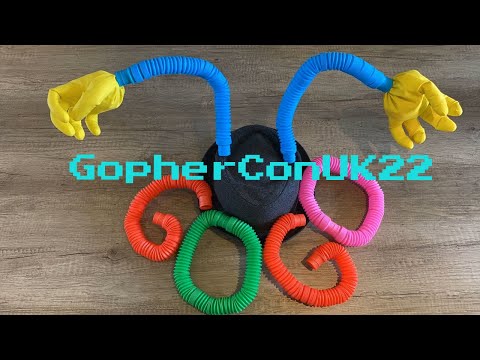
Funny hats have been a good way to draw an audience to a talk, but it also made it clear that the talk was supposed to be a funny talk.
Find a Co-presenter

Paul Cadman and I preparing a talk
I did several talks about company internal products. The one that was most fun, was one I did with a co-presenter. Presenting with someone else has some amazing advantages:
-
You are not up there alone, so there is less anxiety;
-
Bouncing ideas of each other makes creating the presentation much more fun;
-
There are less lines for each of you to learn, so it is easier to prepare;
-
It is much more engaging for the audience to listen to two speakers instead of one.
All creativity comes out of play - Logan Murray.
Even though Logan has some great writing games, for which you don't need a partner. I prefer playing with someone else over playing with myself.
Lesson: Having a co-presenter is easier and a lot more fun for you and the audience.
The Loudest Laughs aren't prepared
During the Stand-up Comedy Course, Logan also gave us tips for how to handle the hazards of the actual show:
Never Ignore Interruptions: If it's annoying you, it is probably annoying the audience as well. Simply mentioning it can get you a laugh.
At my first stand-up gig, an audience member in the front row stood up in the middle of my set. I got my loudest laugh by simply thanking them for leaving.
Another time, when we were presenting an introduction to the Coq Proof Assistant at a conference, we kept mentioning that this was only a taste. I could hear the audience snickering and then it clicked, they saw a joke that I hadn't seen before, so I went for it. "If you don't like the taste Coq then you can also try some other proof assistants like …". We got our loudest laugh of the talk.
This inspired me to take some Improv classes with Scarlett Verey and Jennifer Jordan to eventually do a show, so that I can learn to create more of these great moments in collaboration with the audience.

The Improv show. It is a sweaty business
Besides being incredibly fun and hurting my back, which made me discover the wonders of physio therapy, the two most important lessons I learned was:
-
Listen. If you don't listen, then you can't collaboratively create the funny.
-
What is obvious to me isn't obvious to others.
You want to kill your inner critic. Another way to do this is to imagine you are playing a character based on yourself and then just say what you would imagine your character would say in that situation. This takes the pressure of trying to be smart.
Find your inner idiot - Logan Murray
I found these Improv skills not only improved how I handle the Q&A part of talks, but also how I interact with the audience during the talks, for example during a talk on Logic Programming, I was also able to play more confidently with the audience, making them say ooooo like 3 times in a row without skipping a beat, so awkward, but so fun.
Anxiety as a Tool
Time to dissect anxiety:
Anxiety is your body's way of telling you that it is ready. The thought of negative consequences triggers glands to secrete the hormone ACTH. This hormone results in the release of adrenaline into your blood and that's what causes these uncomfortable feelings. This is essentially your body's most alert and heightened state. It means you're ready. You want to focus on embracing this feeling. When you feel it, be happy. It means your body is in its peak condition to face a challenging or worrying situation. - Do You Talk Funny - David Nihill
This is the same lesson I got from Logan Murray, just slightly more explained.
You want to fully embrace your heightened state of alertness
Now, I need anxiety before a talk! This is the energy I need to be at my most alert. I need my nifty nerves. It is the energy I need to go on stage.
Anxiety is there
to help me prepare
and assure I am aware
concentrated aerated care
Conclusion
I hope it was clear that I started out as the worst public speaker, probably ever, but now I am able to give an acceptable talk at a conference.
Thankfully, persistence is a great substitute for talent - Steve Martin
I practiced, took classes and learned that public speaking is scary for everyone, but that anxiety is the fuel we need to give a great talk.
If you are not scared to try something or do something then why are you doing it. Everything that is exciting scares me a little bit - Trevor Noah
Thank you
-
Elaine Blackmore Co-Founder of WholeLottaComedy for proof reading.
-
Liza Schulze for proof reading and always being my dry-run audience.
-
Robert Koning for proof reading.