goderive

A gopher with blurred gonads
In 2017, I built goderive to demo what Go would look like with generics. Usually, people post about a new tool they’ve developed, but today I will show you a tool I developed about six years ago, just after it got superseded by generics. I am partially kidding, though. This tool still has quite a few use cases that aren’t covered by generics and some valuable lessons that this tool stole from other languages that we can still learn from.
For example:
-
goderive goes beyond generics and towards Higher Kinded Types,
-
goderive learns lessons from functional programming about how to apply generics and
-
goderive is a code generator, so it can cover use cases that generics cannot.
I’ll give you a little taste of goderive with some demos, and I will also explain the provocative subtitle and why the picture of the gopher has a blurred area.
If you prefer, you can watch the following talk instead of reading the article, as it covers the same material:
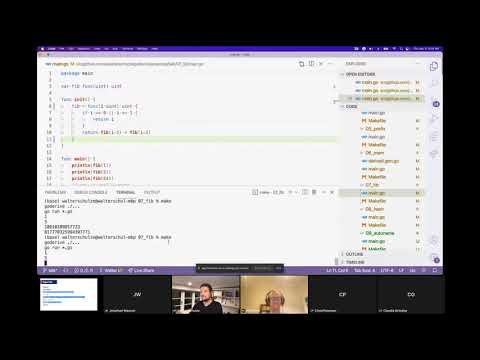
Go Cape Town Meetup
Pros and Cons of Code Generation
Code generation definitely has its pros:
-
Automated (less work for me)
-
Safer (less chance for inconsistencies)
-
Faster (compared to reflect)
Someone on the team always complains about adopting a new tool. In the case of code generation, I have heard them all:
-
One more thing to learn
-
Unreadable (hard to debug and reason about generated code)
-
Too much code (slows down compilation)
-
Slow to generate
-
Not formatted
goderive has some design principles that try to address some of these concerns.
Design Principles
For goderive, I decided to have some code generation principles to address some of the negatives typically associated with code generation.
Generated code should be:
-
Fast to generate
-
Avoid duplication
-
Readable
-
Formatted
Goderive tries its best to generate readable code and be as close to the code you would have written yourself. It even makes sure that this generated code is already formatted. This seems unnecessary, but not needing to run gofmt over your generated code is a huge time saver. Formatting code can be one of the slowest things in your dev cycle outside of running tests. It is also important the code is generated quickly and that we try to reuse as much of the generated parts to keep compilation as fast as possible.
Demos
Enough ceremony, Let’s see it in action.
Min
I remember when Go was new in 2010, and there was a challenge to see how short one could write a min function that returns the minimum of two numbers. Goderive also allows you to write this in one line:
package main

import "fmt"

func main() {
  x := 19
  y := 39
  m := Min(x, y)
  fmt.Printf("%v\n", m)
}
You simply call the Min function, which doesn’t exist, and run the goderive code generator over your code. goderive will spot that you are calling a function that doesn’t exist and generate it for you in a file called derived.gen.go:
// Code generated by goderive DO NOT EDIT.

package main

// Min returns the minimum of the two input values.
func Min(a, b int) int {
  if a < b {
    return a
  }
  return b
}
It uses the name of the function Min and the inferred input types to determine which function to generate.
This is a simple example that is now covered by generics because I am purposefully starting simple. We will soon see examples that generics cannot cover or cannot cover as well.
Using input types to generate different code
What if we want the minimum of two structs? It is a pretty weird thing to want, but why not.
package main

import "fmt"

type Person struct {
  name string
  age  int
}

func main() {
  x := &Person{"Donna", 19}
  y := &Person{"Ron", 39}
  fmt.Printf("%v\n", Min(x, y))
}
Min doesn’t just work for ints; it generates a compare function, but only if needed to keep code concise and close to the code you would have written yourself. goderive does this by inspecting the input types to decide which version of the Min function to generate.
// Code generated by goderive DO NOT EDIT.

package main

import "strings"

// Min returns the minimum of the two input values.
func Min(a, b *Person) *Person {
  if Compare(a, b) < 0 {
    return a
  }
  return b
}

// Compare returns:
//   * 0 if this and that are equal,
//   * -1 if this is smaller and
//   * +1 if this is bigger.
func Compare(this, that *Person) int {
  if this == nil {
    if that == nil {
      return 0
    }
    return -1
  }
  if that == nil {
    return 1
  }
  if c := strings.Compare(this.name, that.name); c != 0 {
    return c
  }
  ...
  return 0
}
goderive chose to generate a separate Compare function, because then it might be able to reuse it with a Max or Sort function and keep the code concise.
Sort
If we can compare two things, why can’t we sort a list of them?
type Person struct {
  name string
  age  int
}

func main() {
  x := Person{"Donna", 19}
  y := Person{"Ron", 39}
  people := []Person{y, x}
  fmt.Printf("%v\n", Sort(people))
}
goderive uses the input types, together with the function name prefix, to decide which function to generate.
// Code generated by goderive DO NOT EDIT.

package main

import (
  "sort"
  "strings"
)

// Sort sorts the slice inplace and also returns it.
func Sort(list []Person) []Person {
  sort.Slice(list, func(i, j int) bool { return Compare(list[i], list[j]) < 0 })
  return list
}
...
We can generate a Compare function, which means we can easily generate a Sort function that calls the Compare function.
Keys
I spent a lot of time working on this tool, but the only thing I ended up using in production was deterministically looping through a map in one line:
type Person struct {
  name string
  age  int
}

func main() {
  x := Person{"Donna", 19}
  y := Person{"Ron", 39}
  people := map[string]Person{x.name: x, y.name: y}
  for _, name := range Sort(Keys(people)) {
    fmt.Printf("%v\n", people[name])
  }
}
This code returns the keys from the map of people and then sorts the list of keys before ranging over them.
The first time goderive runs over the code, it doesn’t know what the input type for Sort is because the Keys function has not been generated. It does know what the input type for Keys is, so it generated the Keys function and then runs goderive again. This second time, it can determine the input type for the Sort function, so it can also be generated. goderive runs itself multiple times until there are no more functions it can generate.
// Code generated by goderive DO NOT EDIT.

package main

import (
  "sort"
)

// Sort sorts the slice inplace and also returns it.
func Sort(list []string) []string {
  sort.Strings(list)
  return list
}

// Keys returns the keys of the input map as a slice.
func Keys(m map[string]Person) []string {
  keys := make([]string, 0, len(m))
  for key := range m {
    keys = append(keys, key)
  }
  return keys
}
In this case, it doesn’t use sort.Slice, because that is not the code you would have written yourself. It rather uses sort.Strings.
The derive Prefix
In the previous examples, it can be hard to distinguish between the generated functions and the user-written code. In these examples, I have passed the command line parameter --prefix="" to goderive. By default, though (if you do not pass this command line parameter), every generated function is expected to have the prefix “derive.”
type Person struct {
  name string
  age  int
}

func main() {
  x := Person{"Donna", 19}
  y := Person{"Ron", 39}
  people := map[string]Person{x.name: x, y.name: y}
  for _, name := range deriveSort(deriveKeys(people)) {
   fmt.Printf("%v\n", people[name])
  }
}
This way, the code reader can see that the function being called is a generated function. Technically you could specify any prefix you think is appropriate for your code base.
Memoization
In a lot of programming languages, we have memoization, a technique adopted from functional programming, but now also available in other programming languages, like Python, as the functools.cache annotation.
Memoization can be effectively applied to any pure function. You can think of a pure function as a mathematical function, for example, addition. You will always get the same results if you pass in the same values. This function also has no side effects, which might influence the results in future calls to the function.
The deriveMem function takes a function as input and returns a function of the same type. The difference is that this new function will memoize or cache any inputs you pass to it so that it doesn’t do the expensive calculation again for inputs you have passed to it previously.
var re = deriveMem(func(r string) *regexp.Regexp {
  fmt.Printf("compiling regex <%s>\n", r)
  return regexp.MustCompile(r)
})

func main() {
  fmt.Printf("%v\n", re("ab.*").MatchString("abc"))
  // compiling regex <"ab.*">
  // true
  fmt.Printf("%v\n", re("cd.*").MatchString("cde"))
  // compiling regex <"cd.*">
  // true
  fmt.Printf("%v\n", re("ab.*").MatchString("cde"))
  // false
}
In this case, the expensive operation we want to cache is compiling the regular expression. The first regex ab.* matches the strings abc, so it prints out compiling regex and true. The next regex is different; it is cd.* and matches cde, so it again prints out compiling regex and true. The final regex we have seen before, so the memoized function won’t print compiling regex and ab.* doesn’t match cde, so it only prints false.
func deriveMem(f func(r string) *regexp.Regexp) func(r string) *regexp.Regexp {
  m := make(map[string]*regexp.Regexp)
  return func(param0 string) *regexp.Regexp {
    if v, ok := m[param0]; ok {
      return v
    }
    v := f(param0)
    m[param0] = v
    return v
  }
}
The generated deriveMem function returns a closure that contains a map used to look up or store the return values before returning them.
Fibonacci
You can also use deriveMem with recursive functions, but it does require a little trick. This example of Fibonacci shows how we create a variable to store the function and then set the value of the function that is called in the init function. Here’s what the code looks like:
package main

var fib func(uint) uint

func init() {
  fib = deriveMem(func(i uint) uint {
    if i == 0 || i == 1 {
      return i
    }
    return fib(i-1) + fib(i-2)
  })
}

func main() {
  println(fib(1))
  println(fib(5))
  println(fib(64))
  // yes it really works.
  println(fib(1000))
}
The memoization makes this code execute in a timely manner. If you remove the deriveMem the code is equivalent, but it doesn’t finish in a time that I am willing to wait.
Hash
deriveMem also works for more complicated functions. Imagine we have a function called findLastName. It does an API call to find someone’s last name on some other service, which is expensive to call, so we want to cache it.
// expensive function with two parameters.
func findLastName(firstname string, age *int) *string {
  // Mock: Search for a possible last name via an API
  ...
}

var getLastName = deriveMem(findLastName)

func main() {
  age := 2
  fmt.Printf("%v\n", getLastName("Donna", nil))
  fmt.Printf("%v\n", *getLastName("Ron", &age))
  fmt.Printf("%v\n", getLastName("Donna", nil))
}
Now we can’t use a simple map lookup to look up a value and a pointer to a value. We solve this by generating a hash function for a new struct type we create that contains the two input fields called input. We also create a new struct called mem which contains both the input and output values, in case we have hash collisions.
Now we can return a closure that has the memory of map of uint64, hashed input's, to a list of values of mem. The closure hashes the input, looks it up in the map and makes sure it has gotten the correct input values, using deriveEqual before returning, or if it couldn’t find the inputs in the map, it calls the function and appends the result to the map using the hashed input as the key.
// Code generated by goderive DO NOT EDIT.

package main

// deriveMem returns a memoized version of the input function.
func deriveMem(f func(firstname string, age *int) *string) func(firstname string, age *int) *string {
  type input struct {
    Param0 string
    Param1 *int
  }
  type mem struct {
    in  input
    out *string
  }
  m := make(map[uint64][]mem)
  return func(param0 string, param1 *int) *string {
    in := input{param0, param1}
    h := deriveHash(in)
    vs, ok := m[h]
    if ok {
      for _, v := range vs {
        if deriveEqual(v.in, in) {
          return v.out
        }
      }
    }
    res0 := f(param0, param1)
    m[h] = append(m[h], mem{in, res0})
    return res0
  }
}
...
Complicated inputs will need a hash function, but all simpler input parameters generate code that doesn’t require a hash function. This way, we generate the code you would have written yourself instead of always generating the generic code. For example, even if we had two outputs, but the inputs were base types without a pointer, we wouldn’t need a hash function, since this newly created input struct would still be something that a map can handle as a key.
Origins

Dean Learner from Garth Marenghi's Darkplace
I got this idea for goderive from Haskell, where you can generate an Equal, Compare, and String method by simply adding the statement deriving below the struct.
data Person = Person {
  name :: String,
  age :: Int
} deriving (Eq, Ord, Show)
I wanted it to be this easy to introduce these methods for code generation to Go, but I didn’t want to introduce extra syntax or use comments.
func (p *Person) Equal(q *Person) bool {
  return deriveEqual(p, q)
}
On a side note: What do you think this double colon is called that is used before every type field in Haskell? Since the double underscore in Python is called dunderscore, I think the double colon should be called dolon.
Anyway, I learned many other things from Haskell that I would have liked to use in Go.
Error Detention
For example, error handling!

In Haskell, I didn’t need to type if err != nil, but I still got the explicit error checks that I wanted. Let me show you an approximation in Go.
Here we can see a piece of code that translates a user type that is stored on another service. It calls the endpoint to get the user, unmarshals the user, upgrades the user, marshals the user again, and posts it to a new endpoint.
func upgradeUser(endpoint, username string) error {
    getEndpoint := fmt.Sprintf("%s/oldusers/%s", endpoint, username)
    postEndpoint := fmt.Sprintf("%s/newusers/%s", endpoint, username)

    resp, err := http.Get(genEndpoint)
    if err != nil {
        return err
    }
    data, err := ioutil.ReadAll(resp.Body)
    if err != nil {
        return err
    }
    olduser, err := user.NewFromJson(data)
    if err != nil {
        return err
    }
    newuser, err := user.NewUserFromUser(olduser),
    if err != nil {
        return err
    }
    buf, err := json.Marshal(newuser)
    if err != nil {
        return err
    }
    _, err = http.Post(
        postEndpoint,
        "application/json",
        bytes.NewBuffer(buf),
    )
    return err
}
We could also write the same code with goderive using a compose function.
func upgradeUser(endpoint, username string) error {
  getEndpoint := fmt.Sprintf("%s/oldusers/%s", endpoint, username)
  postEndpoint := fmt.Sprintf("%s/newusers/%s", endpoint, username)
  _, err := deriveCompose(
    http.Get,
    func(resp *http.Response) ([]byte, error) {
      return ioutil.ReadAll(resp.Body)
    },
    user.NewFromJson,
    user.NewUserFromUser,
    json.Marshal,
    func(buf []byte) (*http.Response, error) {
      return http.Post(
        postEndpoint,
        "application/json",
        bytes.NewBuffer(buf),
      )
    },
  )(getEndpoint)
  return err
}
The compose function takes two chain-able functions that return an error and chains them together into one callable function.
func compose(
  f func(*A) (*B, error),
  g func(*B) (*C, error),
) func(*A) (*C, error) {
  return func(a *A) (*C, error) {
    b, err := f(a)
    if err != nil {
      return nil, err
    }
    c, err := g(b)
    return c, err
  }
}
This is simple enough to now do with generics, but goderive is smarter and can compose as many functions as you would like:
func compose(
  a func(*A) (*B, error),
  b func(*B) (*C, error),
  ...
  y func(*Y) (*Z, error),
) func(*A) (*Z, error) {
Haskell has special syntax for this, so you don’t have to call compose, but this is the basic idea behind its error handling. Rust also gets around this problem using a question mark operator.
Do Concurrently
What if we wanted to execute two functions concurrently and return a possible error? This is exactly what the deriveDo function does:
func serviceCallOne() (string, error) {
  // some function that calls a service
}

func serviceCallTwo() (int, error) {
  // some function that calls a service
}

func serviceCalls() (string, int, error) {
 return deriveDo(serviceCallOne, serviceCallTwo)
}
The function starts up two Go routines and waits for their completion on an error channel. Once both are finished, it returns the values and the error. Again, deriveDo can take as many functions as input as you want to execute concurrently; it doesn’t just have to be two.
// deriveDo concurrently executes the input functions f0 and f1 and when all functions are finished the first error, if any, and results are returned.
func deriveDo(f0 func() (string, error), f1 func() (int, error)) (string, int, error) {
  errChan := make(chan error)
  var v0 string
  go func() {
    var v0err error
    v0, v0err = f0()
    errChan <- v0err
  }()
  var v1 int
  go func() {
    var v1err error
    v1, v1err = f1()
    errChan <- v1err
  }()
  var err error
  for i := 0; i < 2; i++ {
    errc := <-errChan
    if errc != nil {
      if err == nil {
        err = errc
      }
    }
  }
  return v0, v1, err
}
This function was also inspired by Haskell’s ApplicativeDo extension. I learned a lot more things about concurrency from Haskell, which are more complicated than this simple function, for example, proper cancellation of green threads. This is also something Erlang does really well, but we struggle with in Go.
Monads in Go
One of the hardest things to understand in Haskell is monads. The actual reason that motivated me to build this project was to explain monads to myself. Haskell has generics, but it also has a higher level of generics. When we think about generics, we only think about replacing the types inside our containers, for example, lists and channels with variables, like A or B. At a higher level, we can also replace the containers themselves with a variable, say M. For example, channels and slices are kind of the same, in that you can loop over both of them and could write generic code that could handle either. Each of the types M just need to implement some interface. Another example is the Kleisli arrow, which comes from Category Theory, but you can just think of it as the compose function.
type kleisliArrow = func(func(A) M<B>, func(B) M<C>) func(A) M<C>
type compose = func(func(A) (B, error), func(B) (C, error)) func(A) (C, error)
type pipeline = func(func(A) <-chan B , func(B) <-chan C) func(A) <-chan C
type listComprehension = func(func(A) []B, func(B) []C) func(A) []C
Category Theory studies how we compose things, which is quite important, since one of the few or maybe only ways we know how to solve problems is to break them up into smaller pieces and compose them back together again. In this case, the Kleisli arrow is an interface that can be implemented by errors, channels, and slices, to effectively abstract error handling, a concurrent pipeline, and a list comprehension. You can read more about this in another post: monads for Go programmers.
Monads for Go programmers or Gonads is what goderive allows you to generate.
So Much More

A gopher’s gonads
There is so much more I didn’t cover, but here it is in short.
There are various options for how to handle duplicate function names, which the command line flags help you to set:
--autoname: rename functions that are conflicting with other functions
--dedup: rename functions to functions that are duplicates
--pluginprefix: used to override function prefixes.  The input is a comma separated list of function and prefix pairs.  For example equal=deriveEqual,copyto=copyTo,fmap=fmap
--prefix: prefix of all functions (default "derive")
There are also a lot more functions to explore, such as the following:
Recursive Functions:
-
Equal:
deriveEqual(T, T) bool -
Compare:
deriveCompare(T, T) int -
DeepCopy:
deriveDeepCopy(dst *T, src *T) -
Clone:
deriveClone(T) T -
GoString:
deriveGoString(T) string -
Hash:
deriveHash(T) uint64
Set Functions:
-
Keys:
deriveKeys(map[K]V) []K -
Sort:
deriveSort([]T) []T -
Unique:
deriveUnique([]T) []T -
Set:
deriveSet([]T) map[T]struct{} -
Min:
deriveMin(list []T, default T) (min T) -
Max:
deriveMax(T, T) T -
Contains:
deriveContains([]T, T) bool -
Intersect:
deriveIntersect(a, b []T) []T -
Union:
deriveUnion(a, b map[T]struct{}) map[T]struct{}
Fmap:
-
deriveFmap(func(A) B, []A) []B -
deriveFmap(func(rune) B, string) []B -
deriveFmap(func(A) B, func() (A, error)) (B, error) -
deriveFmap(func(A) (B, error), func() (A, error)) (func() (B, error), error) -
deriveFmap(func(A), func() (A, error)) error -
deriveFmap(func(A) (B, c, d, ...), func() (A, error)) (func() (B, c, d, ...), error)
Join:
-
deriveJoin([][]T) []T -
deriveJoin([]string) string -
deriveJoin(func() (T, error), error) func() (T, error) -
deriveJoin(func() (T, ..., error), error) func() (T, ..., error)
More functional functions:
-
Filter:
deriveFilter(pred func(T) bool, []T) []T -
All:
deriveAll(pred func(T) bool, []T) bool -
Any:
deriveAny(pred func(T) bool, []T) bool -
TakeWhile:
deriveTakeWhile(pred func(T) bool, []T) []T -
Flip:
deriveFlip(f func(A, B, ...) T) func(B, A, ...) T -
Curry:
deriveCurry(f func(A, B, ...) T) func(A) func(B, ...) T -
Uncurry:
deriveUncurry(f func(A) func(B, ...) T) func(A, B, ...) T -
Tuple:
deriveTuple(A, B, ...) func() (A, B, ...) -
Mem:
deriveMem(func(A...) (B...)) func(A...) (B...) -
Traverse:
deriveTraverse(func(A) (B, error), []A) ([]B, error) -
ToError:
deriveToError(error, func(A...) (B..., bool)) func(A...) (B..., error) -
Apply:
deriveApply(f func(...A, B) C, B) func(...A) C
Concurrency functions:
-
Fmap:
deriveFmap(func(A) B, <-chan A) <-chan B -
Join:
deriveJoin(chan T, chan T, ...) <-chan T -
Pipeline:
derivePipeline(func(A) <-chan B, func(B) <-chan C) func(A) <-chan C -
Do:
deriveDo(func() (A, error), func() (B, error)) (A, B, error) -
Dup:
deriveDup(c <-chan T) (c1, c2 <-chan T)
The tool is pretty extendable if you would like to add your own functions or even remove some you wouldn’t like to see being applied in your code base.
Thank you
-
Marius van Zyl for having the idea and pushing me to do talk on goderive.
-
Neil Garb for organising, recording and supporting the talk at the Go Cape Town meetup.